
Exactly two lotto matches or at least two: count the right outcomes
“Exactly two matches” excludes three matches; “at least two” includes them. The difference is small in wording but real in the outcomes being counted. A probability for a broad match threshold should not be substituted for a single exact-match prize bracket.
This guide in the okbet lottery section uses a small fictional draw so every outcome can be checked. It explains the counting question, not the prize rules of a current lottery. Whether a real product awards only one bracket or combines awards requires its specific rules.
A three-number example with 35 possible results
Assume three different numbers are drawn from 1 through 7, order does not matter and all complete three-number sets are equally likely. A fixed example entry contains 1, 3 and 6. There are C(7,3) = 35 possible drawn sets. The three entry numbers form one group; the four numbers not on the entry, 2, 4, 5 and 7, form the other.
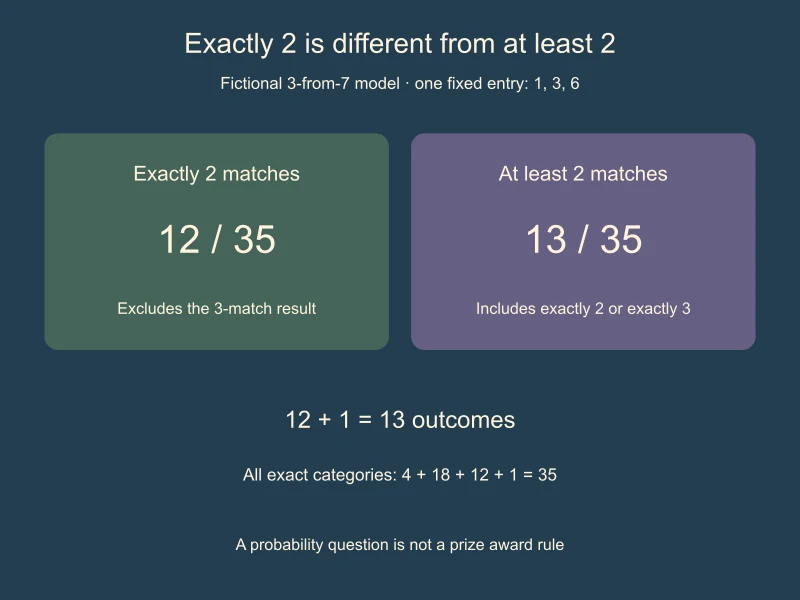
To get exactly two matches, select two of the three entry numbers and one of the four other numbers. There are C(3,2) × C(4,1) = 3 × 4 = 12 such results. The result 1, 3, 5 qualifies. The result 1, 3, 6 does not: it has three matches.
To get at least two matches, include those 12 results plus the one result with all three entry numbers. That gives 13 out of 35, instead of 12 out of 35. No new ticket has been added; the question includes one more possible result.
| Question in the fictional draw | Outcomes included | Count out of 35 |
|---|---|---|
| Exactly two matches | Two entry numbers and one other number | 12 |
| Exactly three matches | All three entry numbers | 1 |
| At least two matches | Exactly two or exactly three | 13 |
Use non-overlapping categories before adding them
The exact-match categories do not overlap: a result cannot have exactly two and exactly three matches at the same time. That is why their counts can be added to answer the “at least two” question. Do not add the count for “at least two” to the count for “exactly three”; the three-match result would be included twice.
As a complete check, the possible results divide into zero matches: C(4,3) = 4; one match: C(3,1) × C(4,2) = 18; two matches: 12; three matches: 1. The sum 4 + 18 + 12 + 1 is 35, matching the full result space.
The method depends on sampling without replacement
OpenStax’s hypergeometric explanation concerns counts from two groups sampled without replacement. For this example, the groups are the entry numbers and the other numbers. The assumptions and all worked lottery counts here are the article’s own, rather than a claim about a real product’s odds or operation.
If a game allows repeated digits, requires a particular order or gives an additional number a separate role, this three-distinct-number model is not enough. Establish the matching rule before using its formula. The mathematical count does not establish whether an entry was accepted for a specific draw.
The same wording difference matters in a larger set model
For a separate assumed fair, unordered six-from-42 model, a fixed six-number entry has 36 other numbers outside it. Exactly four matches can occur in C(6,4) × C(36,2) = 9,450 results. Exactly five occur in C(6,5) × C(36,1) = 216 results. Exactly six occur in one result.
At least four therefore counts 9,450 + 216 + 1 = 9,667 results out of C(42,6) = 5,245,786. The numerator 9,450 answers the exact-four question; 9,667 answers the broader threshold. Neither numerator is a cash prize, a verified current PCSO rule or evidence of an actual claim.
Entry coverage and match thresholds are separate choices
This guide fixes one entry and changes the question asked about its matches. Buying or listing several entries is a different operation. Before analyzing a bundle, use the guide to counting unique combinations in two lotto bundles to identify repeated complete sets for the same draw.
Several entries may also reach the same lower-match threshold on the same result. Their outcome events can overlap, so multiplying a single-entry “at least” probability by the number of lines need not give the probability of any qualifying line. That requires a separate union calculation for the actual sets.
Record the question beside the answer
For the small example, write “one fixed entry 1, 3, 6; fair unordered three-from-seven model; at least two matches; 13/35.” If the question changes to exactly two, the answer becomes 12/35. Keeping the condition with the number prevents a broader threshold from being relabelled as an exact bracket.
Source and full enumeration checked on 10 October 2026. The example is a reproducible counting exercise; it provides no prediction, verified payout or reason to increase spending.